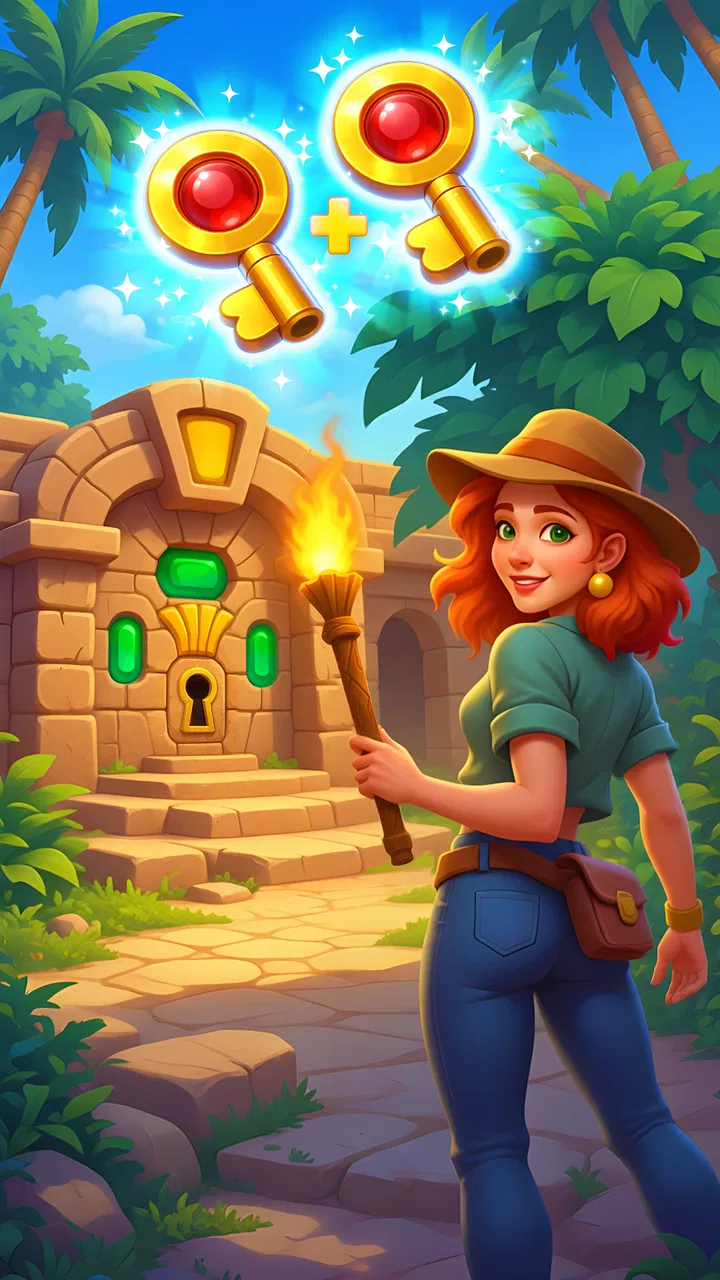
World Tour Merge: Merging Game
- 4.9
- Rating
- 1.00M
- Installs
- Free
- Price

 Analysis by App-foxy
I found World Tour Merge: Merging Game easiest to understand in a shared-device situation. One person can pick it up for a short puzzle session, then another household member can continue exploring the same general style of merge activity later. The idea is familiar: combine matching items, make room on the board, and use the resulting objects to work through tasks connected with charming travel locations. What makes it pleasant is the relaxed rhythm. I never felt pushed to react quickly, so it suited those small gaps in the day when I wanted something more involving than scrolling but less demanding than a competitive game.
That calm presentation should not be mistaken for a completely effortless experience. Every merge uses space, and every new object creates another decision about what to keep, combine, or postpone. I enjoyed that gradual pressure because it gives the game a little more substance than simply tapping identical pieces together. At the same time, it means the game rewards patience and planning rather than random activity. If you prefer instant answers, fixed grids, or puzzles that can be solved in a few carefully defined moves, this may feel more open-ended than you want.
How the travel-and-merge loop works in everyday play
The central appeal is the way small combinations build toward larger objectives. I usually began by looking across the available items instead of merging the first obvious pair. That quick pause matters: a careless combination can leave awkward gaps, while a better sequence keeps the board useful for the next few actions. The travel theme gives those decisions a sense of direction, even when the immediate task is simply arranging objects and completing a request.
You May Also Like

 Blood Strike: 2.5 Anniversary
Blood Strike’s Loadouts Turn Every Drop Into a Tactical Gamble
A close look at Blood Strike’s custom loadouts: how fast access to signature weapons reshapes its battle royale rhythm, rewards preparation, and narrows the gap between fights.

 Pandora - Music & Podcasts
Pandora’s Music Is Easy to Start, but Harder to Recover
Pandora’s strength is its low-effort path from a seed to a station. Its weak spot is how much confidence it asks you to place in connection, setup, and quiet recovery.

 8 Ball Pool
 Is Built on Rivalries, Rematches, and Routine
A close look at the rivalries, rematches, shared routines, and unanswered safety questions that turn a quick pool match into a persistent mobile community.

 Samsung Music
’s Quiet Strength Is Playing What You Already Own
Its reach comes less from spectacle than from dependable access to a personal library. That simplicity is both the app’s strongest retention engine and its ceiling.

 AccuWeather: Weather Radar
AccuWeather Review: A Quick, Clear Forecast for Everyday Decisions
For everyday plans, the best forecast is the one you can understand quickly. AccuWeather makes rain timing, radar, and local conditions easy to act on, with a few trade-offs.

 Hill Climb Racing
Why Hill Climb Racing Still Turns Crashes Into One More Run
A tiny car, a bumpy hill and one more upgrade: Hill Climb Racing keeps resurfacing because its simple chaos makes every near-miss feel personal.
More From Our News Desk



For a household, this makes the game easy to pass between people without needing everyone to be equally skilled. A child may enjoy spotting matches and watching a new item appear, while an older player may focus on planning the board. Someone returning after a break can usually understand the visible objective without learning a complicated control scheme. I would still encourage each person to agree on when to stop, because the most interesting decisions often happen just before the board becomes crowded.
One useful habit is to treat empty spaces as a resource rather than decoration. I found it tempting to merge immediately whenever two items matched, but holding a piece for a moment sometimes created a more flexible arrangement. Another practical approach is to inspect the whole board after every meaningful combination. The result of one merge can reveal a second opportunity, and acting too quickly can make that opportunity harder to use. These are small choices, but they are what keep the puzzle layer from becoming automatic.
The game is free to start, which makes it straightforward to try on a family tablet or personal phone before deciding whether it belongs in a regular rotation. Optional purchases range from $0.99 to $134.99 per item, so I would not treat the word “free” as a complete description of the spending experience. In a shared household, that distinction matters. The person playing should know that in-app purchases exist, and the device owner should handle any purchase decisions rather than leaving them to whoever happens to be holding the phone.
What sharing the device feels like
World Tour Merge works best when sharing means taking turns, not constantly interrupting another person’s plan. Merge boards are personal in a quiet way: one player may be saving pieces for a future combination, while another may see the same items as clutter that should be cleared. If several people use one device, a simple spoken rule helps: finish the current objective or leave the board in a clearly understandable state before handing it over.
I also found that short sessions are more comfortable than trying to force a long play period. The gradual puzzle structure makes it easy to return later, but a crowded board can become mentally tiring when I keep pushing through without a break. For a parent and child, taking turns after a small goal feels more cooperative than passing the device after every move. It also gives the child a chance to explain why a particular item should be kept, which turns the game into a light exercise in planning rather than pure tapping.
There is a trade-off here. Shared play can make the game more social, but it can also remove the quiet, personal decision-making that gives merge puzzles their charm. A player who likes arranging everything according to a private strategy may become annoyed if someone else moves pieces unexpectedly. I would therefore recommend separate play sessions on a shared device, with a clear handoff, rather than treating the board as a communal sandbox.
Boundaries worth setting before anyone starts
The most important boundary is spending. Because the game is available without an upfront price but includes optional purchases, I would set a household rule before the first session: no purchase happens without the device owner’s permission. That rule is more useful than assuming everyone understands how store payments work. It is especially important when the game is installed on a phone or tablet used by several people, since the person playing may not be the person responsible for the account.
A second boundary concerns progress and responsibility. If several people use the same installation, agree on whether the board belongs to one player or whether taking turns is acceptable. I would avoid promising a child that another person will never touch the game unless the household has actually arranged that. The safest approach is simple coordination: one main player, or a clearly announced turn system. That prevents a well-intentioned helper from spending an item another player had been saving.
Account boundaries deserve equal attention. The game itself should not be treated as a substitute for the device’s account settings or the store’s purchase protections. A parent or owner can decide who may use the device, who is allowed to install games, and who can approve spending. Those decisions sit outside the puzzle board, but they shape whether the experience remains comfortable. I would keep the game associated with the appropriate device account and avoid sharing payment access casually.
There is also a practical boundary around attention. The relaxed pace makes the game suitable for a break, but “relaxed” does not mean it belongs in every situation. I would not hand it over during homework, a family conversation, or a task that requires concentration. For a younger player, a short agreed session is easier to manage than an open-ended promise to stop later, particularly because the board can always offer one more merge or objective.
Coordinating progress without spoiling the puzzle
Good coordination does not require turning the game into a family project. In my experience, the best arrangement is to let the main player make the important decisions and invite others to help only when asked. A second person can suggest which pieces appear useful, but the person controlling the board should have the final say. That preserves ownership and prevents the common shared-device problem where advice quietly becomes control.
For younger players, I would use questions instead of instructions. Asking “What could you combine next?” encourages observation, while telling them exactly where to tap removes the satisfying part of the puzzle. The travel setting also gives adults an easy way to keep conversation going without inventing rules about the game. You can ask which location seems appealing, what the current task is asking for, or why leaving a space open might help.
One of the less obvious strengths is that the merge loop creates natural stopping points. Completing a request or reaching a tidy board arrangement feels like a better handoff moment than stopping in the middle of a complicated setup. I recommend taking a quick look at the board together before ending a session. That small ritual reduces accidental changes and makes it easier for the next player to understand the plan.
Coordination becomes less pleasant when players have different expectations. Someone looking for a soothing pastime may dislike another person urging them to optimize every move. Conversely, a strategy-minded player may find casual merging wasteful. This is where the game compares favorably with turn-based competitive puzzles: there is less pressure to beat another person, but there is still enough board management for disagreements about approach. It is cooperative only if the household chooses to make it cooperative.
Age suitability and the question of trust
The content rating is Everyone, and the basic premise is approachable enough for a broad audience. I would still judge suitability by the individual child rather than by the label alone. The game asks for patience, visual attention, and an ability to accept that not every desirable combination can happen immediately. A child who enjoys sorting, matching, and gradual goals may settle into it quickly. A child who becomes frustrated when progress is slow may prefer a puzzle with shorter, more definite rounds.
Trust matters because the game includes optional purchases. An Everyone rating describes the content context, not a household spending agreement. I would explain the difference plainly: the game can be played as a free download, but some items can cost real money. That conversation is more valuable than assuming a child will understand a purchase screen or recognize the importance of an account boundary.
For adults sharing with children, I would also pay attention to how the child handles unfinished goals. The gentle travel atmosphere may make the game feel harmless, yet the board can still encourage “just one more” decisions. A timer is not necessary to enjoy it, but a household routine can help: play after a task, stop at a chosen point, and return later. Since the game is not built around frantic reactions, stopping between objectives usually feels natural.
Older players may appreciate the same qualities for different reasons. The merge system is easy to approach, but planning space and combinations gives it enough texture to occupy attention. It is a better fit for someone who wants a quiet puzzle with a decorative travel frame than for someone seeking a demanding logic challenge. Compared with traditional crossword, sudoku, or nonogram apps, it is less about deriving one correct answer and more about managing a changing collection of objects. Compared with fast match-three games, it feels slower and more deliberate.
Where it stands beside other puzzle choices
World Tour Merge sits in a middle ground. It has the immediate readability of a matching game, but the open board gives decisions more persistence than a sequence of isolated levels. The travel theme adds a sense of movement without changing the fact that the main pleasure comes from combining items and organizing space. I found that combination more welcoming than a purely abstract puzzle, especially when I wanted a game with a little atmosphere.
That same structure is the reason I would not recommend it to everyone. Players who want a clean, finite challenge may prefer sudoku or logic-grid puzzles, where the rules define a sharper path to completion. Players who want action, competition, or rapid rewards may be happier with a conventional match-three title. This game is strongest for people who enjoy gradual development and do not mind making several small decisions before seeing a larger result.
It also differs from many casual puzzle alternatives in how easily a session can become a planning exercise. You are not merely looking for a match; you are deciding whether the current board is ready for one. My practical advice is to avoid judging the game after only a few hurried taps. Its character appears when you slow down, examine available space, and accept that preserving flexibility can be more valuable than immediate progress.
Performance expectations should remain sensible. The current version is 5.1.0, and it runs on Android 7.0 or later, so compatibility covers a wide range of devices that are still in use. I would nevertheless install it on the device where it will actually be played and check how comfortable the screen feels for repeated board management. A small phone can work, but a larger display may be friendlier for shared use, especially when two people are discussing possible moves.
Who will enjoy it, and who should skip it
I would recommend it to a player who likes calm progression, visual organization, and puzzles that leave room for personal choices. It is particularly suitable for a household looking for a low-pressure game that can be explained quickly and revisited in short sessions. The travel framing makes it more inviting than a bare collection of merge tiles, while the board decisions give adults a reason to keep playing after the novelty of matching wears off.
I would be more cautious with anyone who dislikes optional purchases appearing in free games, even when they never intend to buy anything. The presence of items priced from $0.99 to $134.99 per item means the household should be comfortable managing that boundary. I would also skip it if the goal is a fully shared, constantly changing family board. The game is easier to enjoy when one person’s plan is respected, not when everyone rearranges the same space whenever they pass by.
Its reception suggests that many players have found the formula appealing: it holds an average rating of 4.9 from around 19 thousand ratings, with over 1 million installs. Those figures help explain why it has visibility among casual puzzle games, but they do not remove the personal question of whether merge planning suits you. I would use them as reassurance that the concept has broad appeal, not as a reason to ignore the spending, pacing, or shared-device considerations.
My household verdict
After spending time with it, I see World Tour Merge as a friendly puzzle for households that can agree on simple rules. Its best quality is the balance between accessibility and small strategic choices: anyone can understand the matching idea, but careful players still have reasons to inspect the board and plan ahead. The travel setting gives the activity a warmer identity, and the unhurried pace makes it comfortable for a quiet evening or a short break.
My main reservation is not the merging itself; it is the context around a free game with optional purchases. I would install it for a family only after deciding who controls spending, who owns the progress, and how turns work on a shared device. Those boundaries take little effort and prevent most of the frustration that can come from accidental purchases or overwritten plans.
SoloBand Games has made a puzzle that is easy to enter but more thoughtful than its simple controls suggest. I would recommend it to friends who enjoy arranging, collecting, and gradually completing travel-themed goals, especially when they want something gentler than competitive alternatives. I would point elsewhere for a strict logic workout, a quick round-based game, or a completely purchase-free household experience. For everyone else, it is a worthwhile free starting point—as long as the person holding the device also understands the limits of the account behind it.
FAQs for World Tour Merge: Merging Game
01What is World Tour Merge: Merging Game?
World Tour Merge: Merging Game is a casual puzzle adventure built around combining matching objects to create upgraded items. As you merge pieces on the board, you complete tasks, unlock new areas, and progress through a travel-themed world tour. The gameplay is easy to understand, but limited space and increasingly demanding objectives add a strategic element that keeps each level engaging.
02How do you play World Tour Merge: Merging Game?
The main objective is to drag identical objects together so they merge into a more advanced item. New pieces can be generated, moved around the board, and combined to fulfill character requests or level goals. Planning is important because the board can become crowded quickly. Saving space, prioritizing useful combinations, and avoiding unnecessary merges makes progression smoother.
03Is World Tour Merge: Merging Game free to download and play?
World Tour Merge: Merging Game can generally be downloaded for free on supported Android and iOS devices. However, like many free-to-play merge games, it may include optional in-app purchases for energy, boosters, premium currency, or faster progress. You can play without spending money, although waiting for energy regeneration or managing resources carefully may be necessary.
04Does World Tour Merge: Merging Game require an internet connection?
An internet connection may be needed for certain features, including advertisements, cloud synchronization, purchases, events, and updates. Some basic gameplay may remain available when you are offline, but the experience can vary depending on the device version and the current game build. For the most reliable access to all features, it is best to play while connected to Wi-Fi or mobile data.
05Is World Tour Merge: Merging Game suitable for children?
The game is generally easy to learn and does not rely on complex controls, making it approachable for casual players and families. Nevertheless, parents should review the age rating and store information before installation because the game may contain advertisements, optional purchases, and event-based promotions. If children use the app, enabling purchase restrictions is a sensible precaution.
Pros
- Relaxing merge gameplay that is easy to learn and play casually.
- Travel-themed locations provide a pleasant visual variety as you progress.
- Short levels make it convenient for quick gaming sessions.
- Combining items offers satisfying chain reactions and clear progression.
- Playable at your own pace without requiring fast reflexes.
Cons
- Energy limits can interrupt longer play sessions.
- Some upgrades and progress may take considerable time to unlock.
- Repeated merging tasks can feel predictable after extended play.
- Optional purchases may be tempting when resources run low.
- The interface can become crowded as more items appear on the board.

World Tour Merge: Merging Game
Gallery